Story Points vs Hours: Choose the Right Estimate
Compare relative sizing, working hours and delivery dates with one practical example. Choose an estimation approach without inventing a points-to-hours formula.

Story points compare the relative size of work within a team. Hours estimate working time. Neither, on its own, tells you the delivery date. Choose the unit around the decision you need to make: compare backlog items, plan a bounded task, or forecast when an outcome might be ready.
A familiar conversation starts with a reasonable question:
Product Owner: “The CSV export is five points. Can we tell the customer it will be ready on Friday?”
Developer: “Five compares it with work we know. We still need to consider the queue, review and the customer's file format.”
The customer needs a useful answer about timing. Changing 5 into 40 hours does not supply the missing information.
In this guide:
- Three questions hiding behind one estimate
- One export, two legitimate planning conversations
- Why a fixed points-to-hours conversion fails
- Give a date answer using history and conditions
- Choose an approach the team can maintain
- Questions teams often ask
Three questions hiding behind one estimate
| Question | Useful starting point | What it leaves open |
|---|---|---|
| How large is this item compared with familiar work? | Team-relative story points | Calendar dates and individual availability |
| How much focused work might this bounded task need? | Hours, with scope and assumptions | Waiting, dependencies and competing work |
| When might the customer receive the outcome? | Delivery history, current capacity and dependencies | Changes in scope and future conditions |
For time-based voting, try the Hours deck for a well-defined task or the Ideal Days deck to estimate several days of focused work.
Neither points nor hours is automatically more accurate. A clear four-hour task estimate can be useful; a confident point value with an unresolved requirement can be misleading. Scrum does not require story points or Planning Poker; see the Scrum Guide.
One export, two legitimate planning conversations
Consider a fictional team adding a CSV export to an existing report. The data endpoint and permissions already exist. The agreed scope includes column headings, date formatting, escaping and verification; scheduled exports and new permissions are excluded.
The team's completed 3-point reference is a report filter. Exporting adds file-generation behavior and spreadsheet compatibility checks, so this team chooses 5. Another team may choose differently. For building your own references, use Story Points Examples.
Later, a contributor estimates four focused hours for the file-generation task, including review corrections. That task is only part of the item: someone must still check representative files and complete the agreed verification. The four hours are an illustrative planning assumption, not a conversion of five points.
If the reviewer is unavailable until Thursday, four working hours do not mean “finished four hours from now.” Equally, adding two people's hours gives person-hours, not elapsed duration: some activities can overlap; others depend on earlier work.
An unknown changes the conversation again: the customer may require a different encoding. Confirm that requirement before settling scope. Adding more points or padding the hours does not answer it.
Why a fixed points-to-hours conversion fails
A rule such as 1 point = 8 hours makes people estimate hours first and rename the result. It also hides whether those hours describe one person's effort, the whole team's effort or elapsed time. Mike Cohn explains this fixed-equivalence problem.
A faster contributor taking over the same agreed item does not, by itself, make the item smaller on the team's reference scale. New scope or newly understood work can change the size. Keep those changes distinct from who is available.
Points can still relate to time through observed delivery. That relationship is contextual and variable, rather than a universal exchange rate. Atlassian's estimation overview describes the relative-sizing approach.
Give a date answer using history and conditions
Suppose our fictional team completed 18, 22, 20 and 16 points in four two-week iterations. A similarly shaped, unchanged backlog of 40 points suggests roughly two to three iterations if the team, capacity and delivery conditions remain comparable.
This is a rough planning scenario from four observations, not a confidence interval or a guarantee. Avoid translating an individual five-point item into “a quarter of an iteration”: queue order, dependencies and the mix of work still matter.
A useful customer answer is: “Our current planning range is two to three iterations for this scope. The file-format decision and reviewer availability could change it. We will update the forecast after the next delivery review.” That example is a communication pattern, not a promised date.
Without relevant history, say so. Clarify a small slice, expose the assumptions and update the forecast as delivery provides evidence. A new point scale cannot manufacture that history.
Choose an approach the team can maintain
- Use points when comparing backlog items with shared references helps the team make scope decisions.
- Use hours when a bounded near-term task needs an explicit working-time discussion. Record what is included and who must contribute.
- Use both only for distinct decisions. Avoid making the team maintain two estimates of every item without a practical reason.
- Revisit the approach if estimates become performance targets or numbers people must defend. More points delivered does not establish more customer value or higher individual productivity.
Changing units midstream also changes your baseline. Document the change and gather new comparable delivery evidence instead of joining incompatible histories.
Questions teams often ask
How many hours is a five-point story?
There is no universal answer. Your own observations may show a broad range. Keep the agreed scope, working effort and elapsed delivery time visible instead of publishing a fixed conversion table.
Should every task have both estimates?
Only if the second estimate supports a separate decision worth its upkeep. Team-relative item sizing and a specific task's working-time plan can coexist without being mathematically equivalent.
Do points remove the need to discuss dates?
No. Stakeholders still need forecasts. Explain the current range, assumptions and next update using relevant history and present conditions.
Start with a shared understanding
In Agilo Planning Poker, teammates can vote privately, reveal estimates and discuss different assumptions. Agree on the unit and reference before the round; the tool does not turn votes into a delivery forecast.
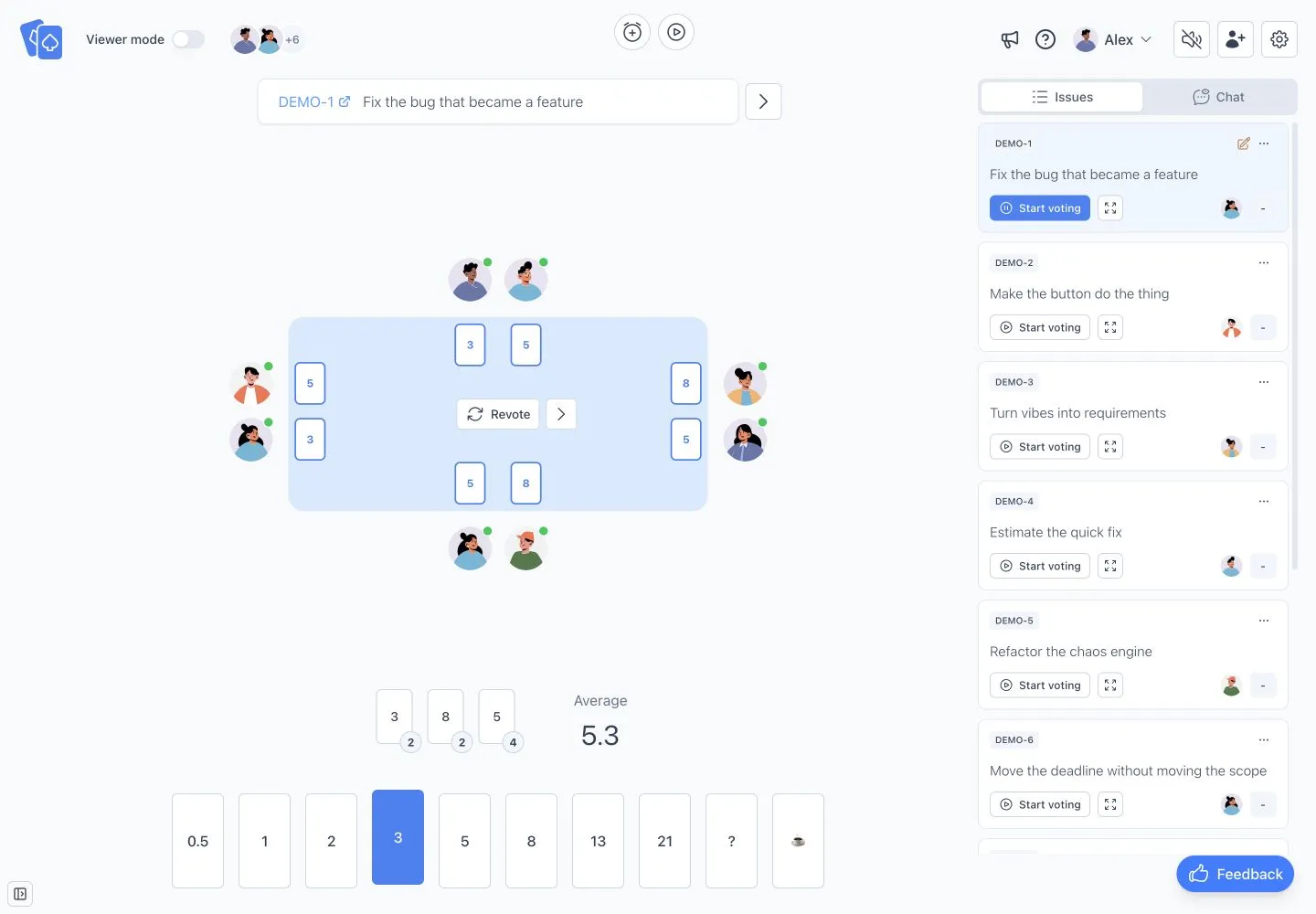
An existing English-interface demo, separate from the CSV example. The votes and displayed average are numbers to discuss, not hours or a delivery date.
For the meeting sequence, read how to run Planning Poker. Use the rules guide to agree how to handle unknowns, and the Fibonacci guide to choose a scale. Then create a room with the team’s shared assumptions beside the backlog.